Optical fingerprinting of logs — finally ready for deployment
Johan Ekenstedt
25 Jun 2026
For roughly two decades, researchers have been circling a deceptively simple idea: that a log can be recognised later from features it already carries, with nothing attached to it — no tag, no paint, no barcode. The cut end of a log, with its growth rings, pith, cracks, knots and saw marks, is distinctive enough to act as a biometric signature, much like a human fingerprint.
For most of those two decades it was a research problem. Today it is something else: a method mature enough to deploy. This is the story of how the field got here — and what it took to turn it into a working service.
Two decades of research
The lineage is longer than most people realise.
- Chiorescu and Grönlund (2003, 2004) introduced the "fingerprint" approach in a sawmill context, using the geometric profile of a log measured by 3D log scanners — combined with RFID — to re-identify logs between the sorting station and the saw intake.
- Barrett (2008) raised the possibility of using the cut end of a log as a biometric identifier specifically to combat timber theft, drawing the analogy with human fingerprint identification.
- Schraml, Uhl and colleagues at the University of Salzburg (2014–2015) turned this into a recognised research line, showing that algorithms developed for human fingerprint and iris recognition could be transferred to digital cross-section images of log ends, and characterising how robust the resulting templates are to crosscutting, drying and different cutting tools.
- The French–Austrian TreeTrace project (ANR-17-CE10-0016, from 2017) consolidated the field by tracking logs along the forest-to-sawmill chain and producing the openly available TreeTrace reference databases of Douglas fir and Norway spruce (Longuetaud et al., 2022).
- From around 2021 the matching pipeline shifted from hand-crafted texture features to deep learning. Wimmer et al. (2021) introduced a two-stage convolutional-neural-network approach — first segmenting the log end, then recognising it — that outperformed the earlier texture-based methods.
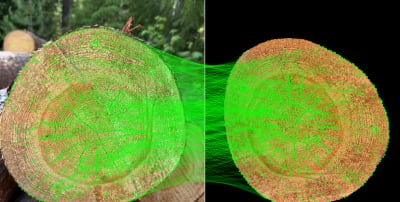
- The most recent step, Martinetto et al. (2024), combined classical feature extraction (SIFT) with deep-learning components (SuperPoint feature detection and the LightGlue matching network) for biometric oak-log traceability, significantly improving on previous results — with reported accuracy approaching 100%.
That last figure is the kind of number that makes any engineer suspicious. When you've spent years working with algorithms that land at 97–99%, a clean 100% sets off every alarm bell. But the result didn't appear out of nowhere. It was a field steadily converging on a robust answer — and that is precisely what makes it deployable rather than merely impressive.
Bringing the method out of the lab
A strong result in a paper is not the same as a method you can run in the field. Closing that gap is where Arboreal comes in. We didn't reinvent the science — we built on the published research and put the pieces together into something practical:
- a cloud solution with a documented API
- an automated segmentation and feature-extraction pipeline
- metadata-based candidate filtering to narrow the search before matching
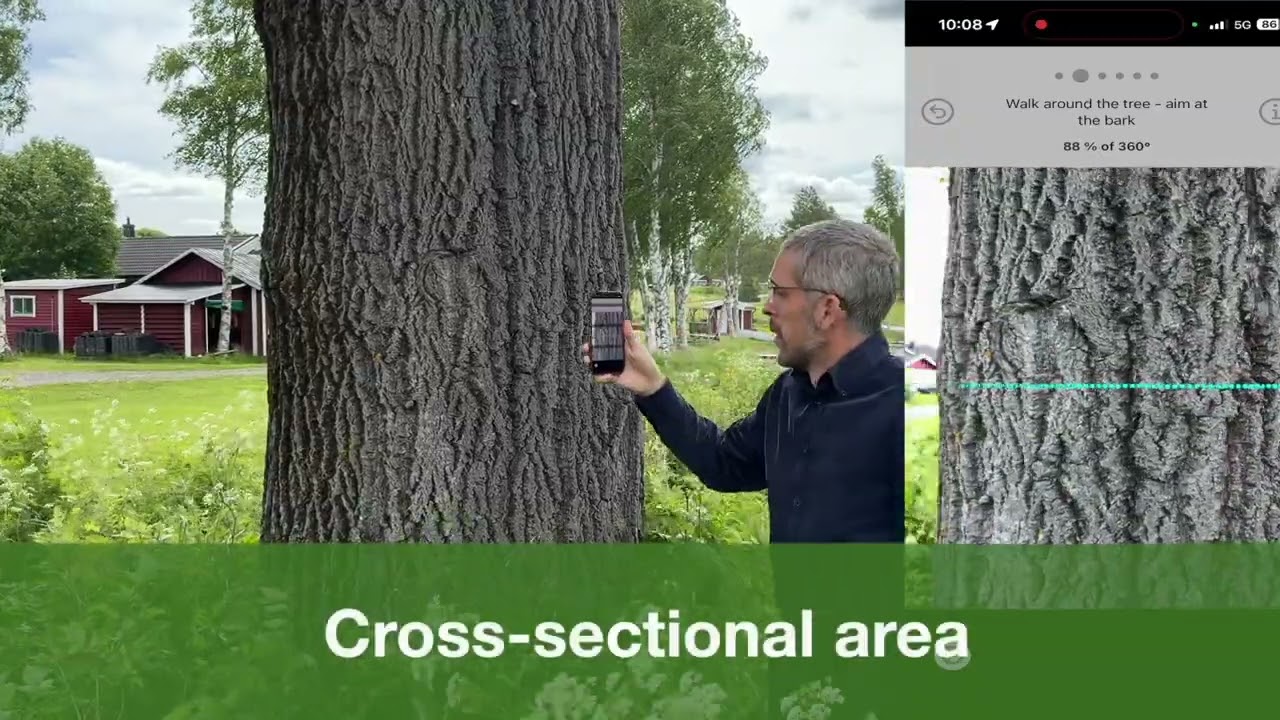
- capture clients in the forest (iPhone or harvester-mounted camera), at the forest landing (iPhone), and at the sawmill (industrial camera)
We're part of the SINTETIC Project, where we follow trees from forest to plank using technologies like RFID. Optical fingerprinting is the complementary method we needed — one that requires nothing to be physically attached to the wood, and that can therefore work even when a tag is lost, damaged, or never applied.
We put it to the test — and it held up
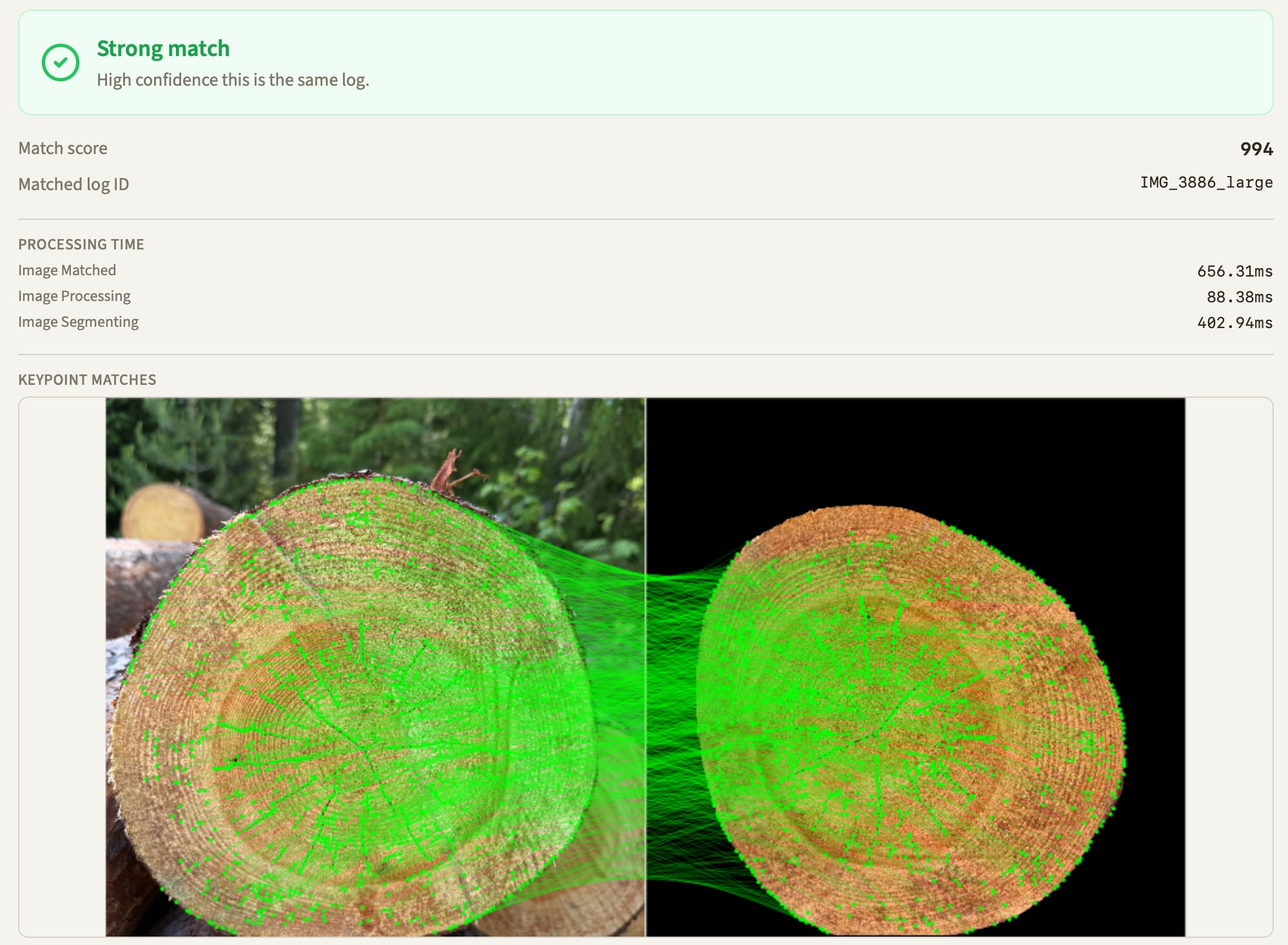
After some work, we now have a running service that performs these identifications, and it works just as well as the research promised. The remaining limitations are entirely reasonable:
- You need images of decent quality
- It's slow
- Segmenting the log end doesn't always succeed
None of these are blockers. They're engineering problems on the path to real-world use, and making the matching faster is exactly what we're focused on next.
The most telling result came when we compared the method against logs tagged with RFID. We found 6 logs that didn't match. For a moment that looked like the method's first failure — until we dug in. The method was right. The mismatches were faulty RFID tag readings. The optical fingerprint turned out to be more reliable than the physical tag it was being checked against.
That, more than any benchmark, is what convinced us the technology is ready to leave the lab.
See for yourself
Twenty years of research has brought optical fingerprinting to the point of deployment. We've set up a service where you can test it yourself.
If you'd like access, you're warmly welcome to reach out and let us know which company or organization you're with — we'll be happy to set you up.
Link to the service: treeid.io
References
Chiorescu, S., Grönlund, A. (2004). The Fingerprint Method: using over-bark and under-bark log measurement data generated by three-dimensional log scanners in combination with radiofrequency identification tags to achieve traceability in the log yard at the sawmill. Scandinavian Journal of Forest Research, 19(4), 374–383.
Barrett, W. (2008). Biometrics of cut tree faces. In: Sobh, T. (ed.) Advances in Computer and Information Sciences and Engineering, pp. 562–565. Springer, Netherlands.
Schraml, R., Charwat-Pessler, J., Petutschnigg, A., Uhl, A. (2015). Towards the applicability of biometric wood log traceability using digital log end images. Computers and Electronics in Agriculture, 119, 112–122.
Wimmer, G., Schraml, R., Hofbauer, H., Petutschnigg, A., Uhl, A. (2021). Two-stage CNN-based wood log recognition. arXiv:2101.04450.
Longuetaud, F., Pot, G., Mothe, F., et al. (2022). Traceability and quality assessment of Douglas fir (Pseudotsuga menziesii) logs: the TreeTrace_Douglas database. Annals of Forest Science, 79, 46.
Martinetto, D., Wimmer, G., Ngo, P., Mothe, F., Piboule, A., Uhl, A., Debled-Rennesson, I., Longuetaud, F. (2024). A new approach to biometric wood log traceability combining traditional methods and deep learning. Smart Agricultural Technology.
Written by

Johan Ekenstedt
CEO and iOS developer at Arboreal. Making it easier to measure, understand and manage trees and forests.
LinkedIn