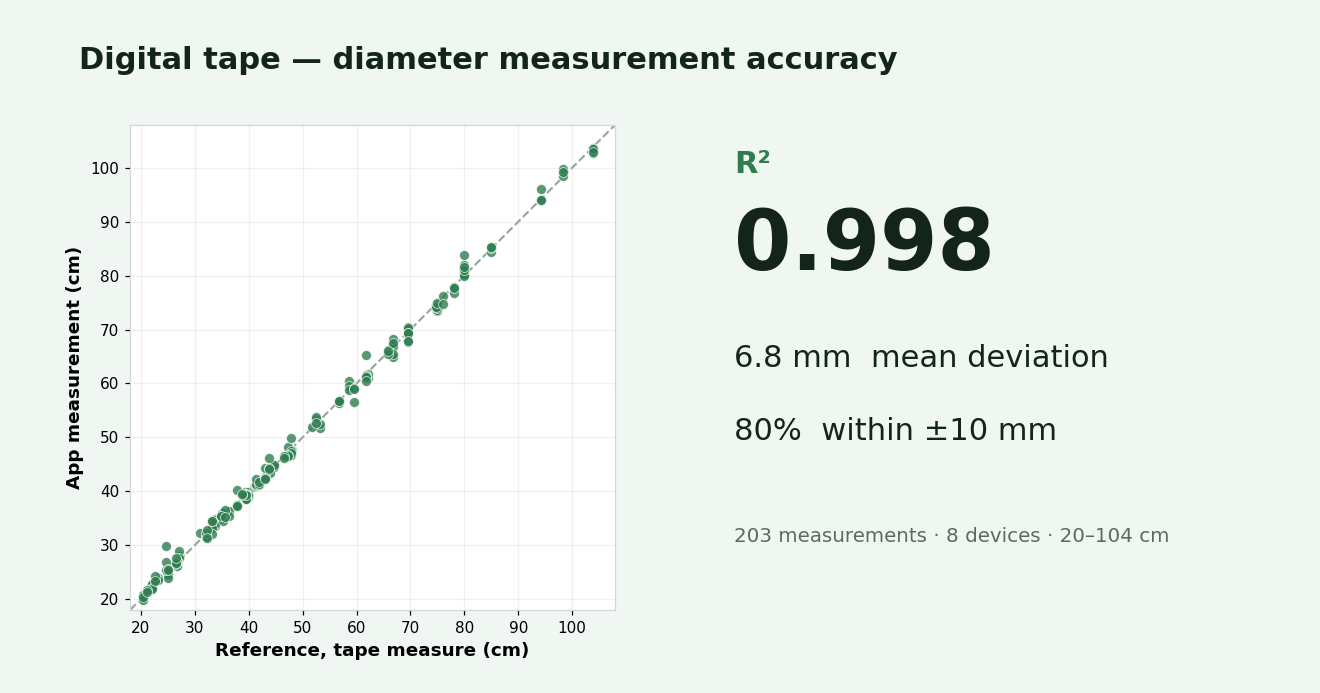
How Accurately Arboreal Tree Measures Diameter — Evaluating the New Digital Tape Measure
Johan Ekenstedt
02 Jul 2026
Two weeks ago we launched the digital tape measure in Arboreal Tree — a new method for measuring diameter, circumference, and cross-sectional area on the biggest trunks straight from your phone. A new measurement method naturally raises one obvious question: how accurate is it, really? So we put it to the test.
How the test was run
We compared the app's measurement against manual measurement with a tape measure (reference) across 203 measurements, spread over 8 different devices — a range of iPhone models and two iPad Pro. Stems ranged from 20 to 104 cm — the method is intended for stems over 20 cm, the thick trees.
The result is clear: the app's measurement tracks the reference very closely.
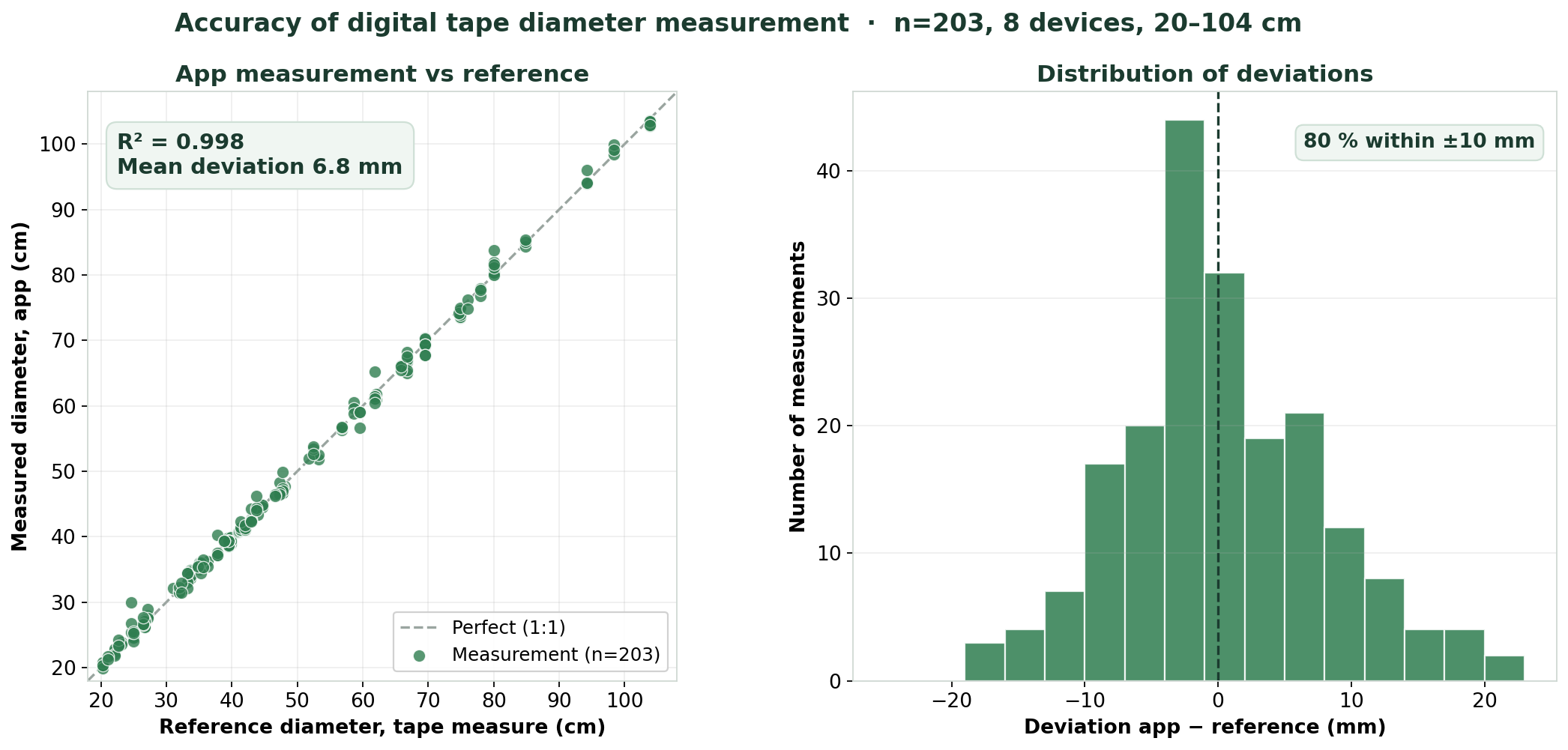
Left: every app measurement against the reference value — the points cluster tightly along the perfect 1:1 line. Right: the distribution of deviations, clearly centred on zero.
Summary
- Mean deviation: 6.8 mm (mean absolute error), equivalent to 1.6 %
- RMSE: 9.7 mm (2.6 %) — a spread metric that weights the larger deviations
- 80 % of all measurements are within ±10 mm of the reference
- 96 % are within ±20 mm
- R² = 0.998 — essentially a straight line against the reference value
- Virtually no systematic over- or under-estimation (mean bias ≈ 0)
Results per device
| Device group | Count | Mean deviation (mm) | Mean deviation (%) | Within ±10 mm |
|---|---|---|---|---|
| iPhone 15–17 Pro | 69 | 5.6 | 1.2 % | 87 % |
| iPhone 12–14 Pro | 53 | 8.1 | 2.2 % | 74 % |
| iPhone 12–15 | 63 | 7.2 | 1.6 % | 75 % |
| iPad Pro | 18 | 5.7 | 1.6 % | 94 % |
| Total | 203 | 6.8 | 1.6 % | 80 % |
The newest Pro models (iPhone 15–17 Pro) and iPad Pro lead the field, but even the older groups stay around or below one centimetre on average — accuracy is stable across new and older devices alike.
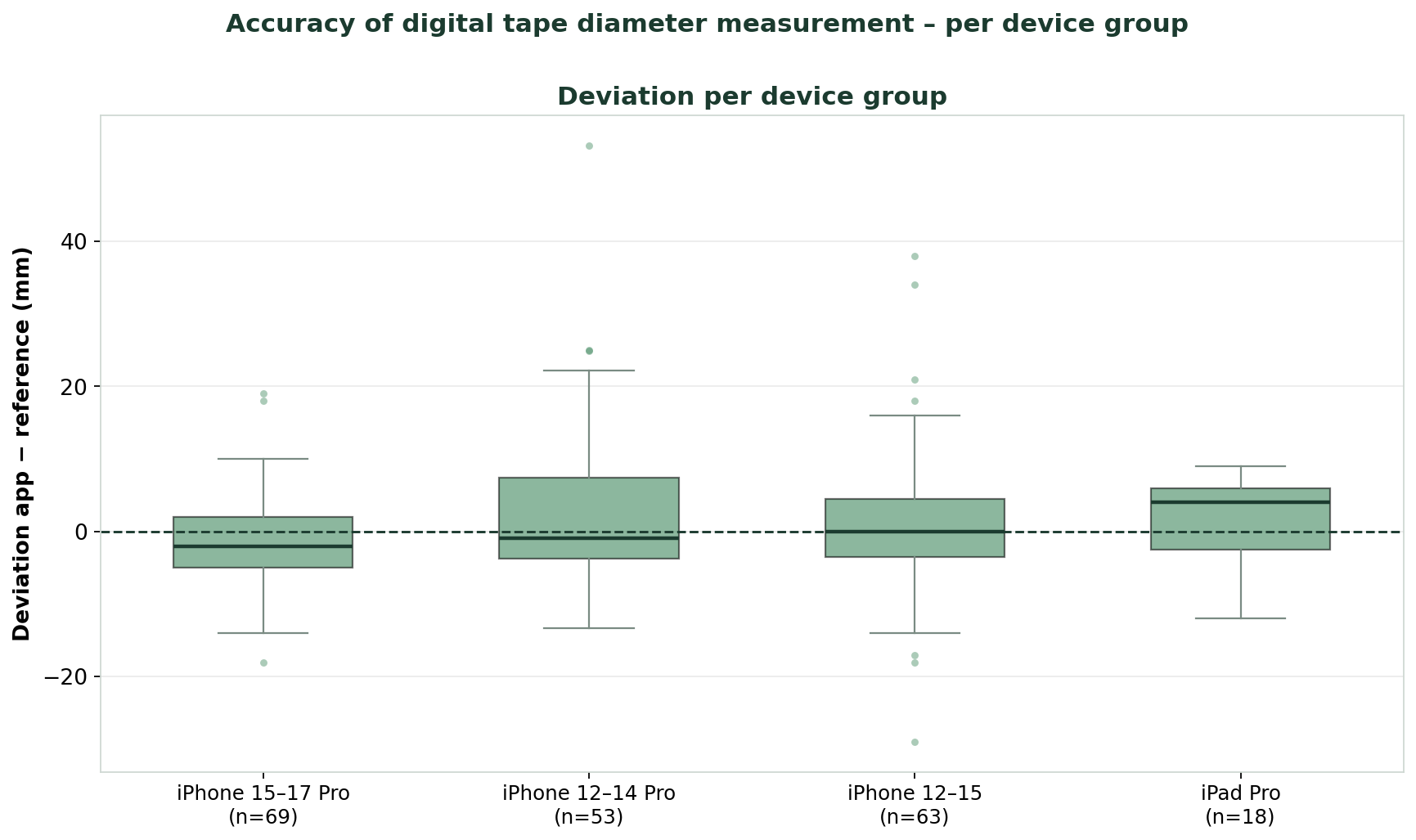
Spread per device group. All groups are centred on zero, and the boxes — where the bulk of measurements fall — are consistently narrow.
What does it mean in practice?
For a typical 40 cm stem, a mean deviation of under 7 mm corresponds to an error of less than 2 %. This means you can measure diameter directly in the field, with the phone already in your pocket, and get a value very close to a manual measurement — with no extra equipment, and even on phones without LiDAR.
The thick trees have always been the hardest to measure accurately. The evaluation shows the new method handles them with room to spare.
About the test: the app's measured value was compared against diameter measured with a tape measure as reference. Measurements were taken on stems in the 20–104 cm range. The method is intended for stems over 20 cm.
There is also some uncertainty in the evaluation itself: the physical tape measure gives slightly different values depending on how straight it is placed around the stem and how tightly it is pulled. The reference is therefore not perfectly exact in itself — but it is the most reasonable and practical way to evaluate the method.
Written by

Johan Ekenstedt
CEO and iOS developer at Arboreal. Making it easier to measure, understand and manage trees and forests.
LinkedIn